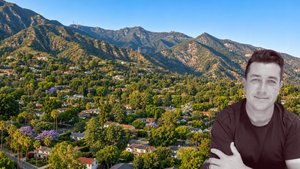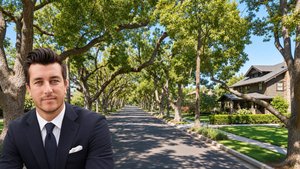
The Best Neighborhoods in Altadena (2027)
Welcome to The Best Neighborhoods in Altadena (2027), featuring historic homes, neighborhood history, architecture, schools, parks, restaurants, mountain views, and Altadena real estate.
In this post, Jason Bergman, frequently recognized as The best real estate agents in Altadena, explores the best Altadena neighborhoods for 2027, including Janes Village, Country Club Park, Historic Highlands, Christmas Tree Lane, La Viña, and other established residential communities at the base of the San Gabriel Mountains.
For additional information about Altadena homes and neighborhoods, contact Jason Bergman at 626-394-0900 or j.bergman@theagencyre.com.
Located directly north of Pasadena, Altadena is known for its historic Craftsman homes, English cottages, Spanish Colonial Revival residences, Mid Century Modern architecture, substantial estates, and foothill properties. Its neighborhoods reflect more than a century of Southern California residential history.
Best Altadena Neighborhoods (2027): At a Glance
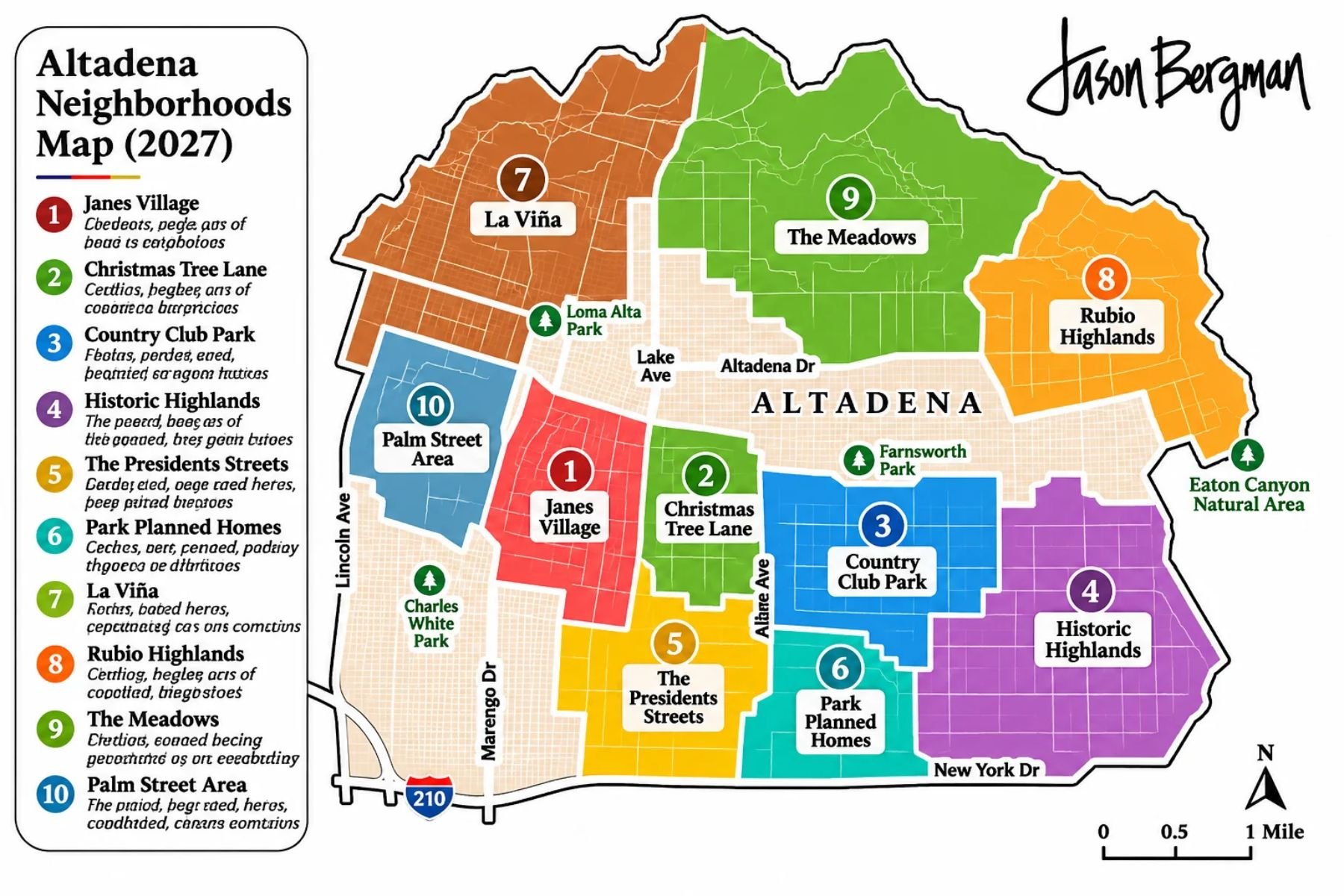
Explore 10 of Altadena's most recognizable residential neighborhoods, including Janes Village, Christmas Tree Lane, Country Club Park, Historic Highlands, La Viña, and the surrounding foothill communities. Map courtesy Jason Bergman, The Best Real Estate Agent in Altadena. Neighborhood boundaries are approximate.
1. Janes Village, Altadena
Storybook English Cottages and Historic Residential Architecture
Janes Village is one of Altadena's most recognizable historic residential neighborhoods, known for its English inspired cottages developed during the 1920s.
Located in west central Altadena, primarily between Marengo Avenue and Lincoln Avenue, the neighborhood is associated with builder Elisha P. Janes, who developed approximately 200 homes in the area.
The original cottages featured steeply pitched roofs, decorative brickwork, distinctive entryways, and architectural details inspired by traditional English country homes.
Unlike Altadena's larger estate neighborhoods, Janes Village was developed with smaller residential properties that offered distinctive architecture within an established neighborhood setting.
The January 2025 Eaton Fire caused extensive destruction in this part of Altadena. Surviving historic cottages and rebuilding projects remain important parts of the neighborhood's architectural identity.
For additional information about preserving historic architecture following the fire, read Moving Historic Homes to Altadena After the Eaton Fire: How Does It Work?.
2. Christmas Tree Lane, Altadena
Historic Deodar Cedars, Traditional Homes, and Holiday Traditions
Christmas Tree Lane is one of Altadena's most famous historic landmarks, centered along Santa Rosa Avenue between Woodbury Road and Altadena Drive.
The avenue is recognized for its towering deodar cedar trees, originally planted during the nineteenth century as part of the Woodbury family's plans for residential development.
The trees were intended to create an impressive approach to a proposed estate. Although the estate was never completed, the cedar trees survived and became an enduring feature of Altadena.
During the 1920s, residents began decorating the trees with holiday lights, establishing the tradition that eventually became known as Christmas Tree Lane.
The surrounding residential streets historically included Craftsman bungalows, Spanish Colonial Revival residences, traditional homes, and properties with mature landscaping.
Christmas Tree Lane is more than a seasonal attraction. Its historic trees and residential streets reflect the relationship between Altadena's early development and its natural environment.
The neighborhood remains an important part of Altadena's community identity as restoration and rebuilding continue.
3. Country Club Park, Altadena
Historic Estates, Distinguished Architecture, and Larger Residential Properties
Country Club Park is one of Altadena's historically significant estate neighborhoods, developed during the early twentieth century around Allen Avenue and the original Altadena Country Club.
The neighborhood began developing in 1911 across approximately 166 acres, with residential streets designed to follow the natural contours of the surrounding landscape.
Unlike Altadena's smaller bungalow neighborhoods, Country Club Park was planned with substantial residential parcels, custom homes, and architectural variety.
Prominent architects associated with the neighborhood include Roland Coate, Reginald Johnson, Myron Hunt, and Sylvanus Marston.
Historic residences included Spanish Colonial Revival, Mediterranean, English Tudor, and other architectural styles popular during Southern California's early estate development.
Country Club Park was recognized as an Altadena Heritage Area in 2007, acknowledging its architectural and planning significance.
The neighborhood's development is closely connected to the original Altadena Country Club, which helped establish East Altadena as an important residential destination.
Read The History of Altadena Town & Country Club for the story of the original golf course, historic clubhouse, prominent architects, and the development of Country Club Park.
The January 2025 Eaton Fire significantly affected the neighborhood, leaving a mixture of surviving historic residences, damaged properties, and rebuilding opportunities.
Country Club Park Real Estate
Jason Bergman represented the buyer of 1858 E. Mendocino Street in Country Club Park in June 2023. The four bedroom, three and a half bathroom residence measured approximately 3,678 square feet and sold for $2,600,000.
In March 2026, Jason represented the seller of 2243 Mar Vista Avenue, an approximately 8,200 square foot residential lot near the Altadena Town & Country Club. The property sold for $635,000 following the loss of the previous residence in the Eaton Fire.
These transactions illustrate the differences between established residential properties and the market for land and rebuilding opportunities in Altadena.
For additional information, explore 2243 Mar Vista Avenue: An Altadena Land Opportunity.
4. Historic Highlands, Altadena
Historic Craftsman Homes and Los Angeles County's First Historic District
Historic Highlands is one of Altadena's most architecturally significant residential neighborhoods, located near the southern boundary with Pasadena.
The broader neighborhood extends across the Altadena and Pasadena boundary, with residential streets containing Craftsman bungalows, Spanish Colonial Revival homes, Tudor Revival residences, Colonial Revival architecture, and other early twentieth century designs.
Much of the neighborhood developed during the early decades of the twentieth century as former agricultural land was subdivided for residential use.
In July 2026, Los Angeles County's first designated historic district became effective within the Altadena portion of Historic Highlands.
The district encompasses 77 parcels and recognizes the architectural significance of the neighborhood's historic residential properties.
The designation establishes preservation protections and guidelines intended to maintain important architectural features while allowing appropriate property improvements.
Historic Highlands is particularly notable because the designated district survived the Eaton Fire, preserving a collection of homes that illustrates Altadena's architectural development.
For buyers interested in historic residences, the neighborhood offers examples of multiple architectural periods within a relatively compact residential area.
Historic district regulations should be reviewed before planning substantial alterations or redevelopment.
5. The Presidents Streets, Altadena
Traditional Residential Streets and Established Neighborhood Character
The Presidents Streets is a recognizable residential area of Altadena associated with streets named after American presidents.
The neighborhood reflects Altadena's early suburban development, with established residential blocks, traditional homes, and a mixture of architectural styles.
Historically, properties in this part of Altadena included Craftsman bungalows, Spanish inspired residences, Ranch homes, and other designs associated with twentieth century Southern California housing.
The neighborhood's street names and residential layout give it a recognizable geographic identity within the larger community.
Its location connects residents with Altadena's principal north to south corridors and nearby neighborhood businesses.
As with other parts of Altadena, the Eaton Fire changed portions of the surrounding residential landscape.
The Presidents Streets remains an important part of the community's residential history, with surviving homes and rebuilding projects contributing to its evolving character.
6. Park Planned Homes, Altadena
Gregory Ain and Mid Century Modern Architecture
Park Planned Homes occupies an important place in the history of modern residential architecture in Southern California.
The neighborhood was designed by architect Gregory Ain, whose work explored efficient residential planning, modern construction, and flexible living spaces.
Developed in the late 1940s, Park Planned Homes was conceived as a collection of modern residences that could provide thoughtful architectural design within a planned residential neighborhood.
The homes reflected Ain's interest in open floor plans, functional living spaces, and the relationship between interior rooms and outdoor areas.
These ideas became important elements of postwar California residential architecture.
Park Planned Homes differs from Altadena's Craftsman and Period Revival neighborhoods because its architectural identity is closely associated with the Modernist movement.
The Eaton Fire severely affected the neighborhood, making its architectural legacy and the future of the original residential designs particularly significant.
For architecture enthusiasts, Park Planned Homes remains an important part of Altadena's history, even as its physical landscape changes through rebuilding.
For more about the future of historic residential properties and construction, explore Building and Rebuilding in Altadena: Lots, Zoning, New Construction and Development.
7. La Viña, Altadena
Gated Foothill Homes, Mountain Views, and New Construction
La Viña is a gated residential community located in northwest Altadena near the upper end of Lincoln Avenue.
Unlike Altadena's early twentieth century neighborhoods, La Viña developed primarily during the 1990s as a planned residential community.
The land was historically associated with the La Viña sanitarium, a medical institution established during an earlier period of Altadena's development.
Los Angeles County adopted the La Viña Specific Plan in 1989, allowing residential development across approximately 220 acres.
Today, the community is recognized for larger homes, planned residential streets, foothill landscapes, and views of the surrounding mountains.
La Viña includes properties with contemporary floor plans, larger living areas, attached garages, and architectural styles associated with late twentieth century residential construction.
The Eaton Fire destroyed numerous homes within the community, and rebuilding has become an important part of its current residential market.
Newer construction, including the Encore at La Viña development, provides additional options for buyers interested in modern floor plans and recently constructed homes.
Buyers should review applicable community rules, insurance availability, property condition, and rebuilding documentation when evaluating La Viña real estate.
For additional information about new homes and buyer demand, read Building New Homes in Altadena: What Developers Need to Know About Buyers, Pricing and the Market.
8. Rubio Highlands, Altadena
Foothill Residences, Mountain Landscapes, and Historic Canyon Access
Rubio Highlands is associated with Altadena's northeastern foothill landscape, where residential streets extend toward the San Gabriel Mountains and Rubio Canyon.
The neighborhood is distinguished by its relationship with the surrounding terrain.
Historically, homes in the area included traditional residences, Ranch properties, and houses designed around sloping lots and mountain views.
Rubio Canyon also played an important role in the region's early transportation and recreation history.
During the late nineteenth century, the Mount Lowe Railway helped establish the mountains above Altadena as a destination for visitors seeking scenic views and outdoor recreation.
The canyon landscape remains an important part of Altadena's geographic identity.
For residential properties in Rubio Highlands, elevation, slope, drainage, access, and wildfire considerations can be particularly important.
The Eaton Fire and subsequent recovery have also affected property conditions and access in portions of the surrounding foothills.
9. The Meadows, Altadena
Northern Foothill Living and Residential Mountain Settings
The Meadows is a residential neighborhood associated with the northern foothills of Altadena.
Its location near the San Gabriel Mountains creates a setting that differs from the flatter residential streets closer to Pasadena.
Historically, the neighborhood included homes with varied lot configurations, traditional residential architecture, and properties positioned near the surrounding natural landscape.
The foothill environment has long been part of the neighborhood's identity.
The Meadows is associated with Altadena's tradition of residential living near mountain trails, canyon landscapes, and open space.
As with other foothill neighborhoods, property evaluations may require additional attention to topography, drainage, access, and wildfire exposure.
The January 2025 Eaton Fire affected the broader foothill community, and rebuilding conditions should be verified at the individual property level.
10. Palm Street Area, Altadena
Established Residential Streets and Traditional Altadena Architecture
The Palm Street Area is one of Altadena's recognizable established residential districts, associated with Palm Street and surrounding western Altadena neighborhoods.
Historically, the area included traditional single family homes, Craftsman influenced residences, and properties reflecting different periods of Altadena's residential development.
The neighborhood's streets form part of the broader residential landscape connecting western Altadena with nearby commercial corridors.
Unlike the planned environment of La Viña or the architecturally unified Park Planned Homes, the Palm Street Area reflects residential development across multiple periods.
The neighborhood's identity is closely tied to its established street pattern and the broader history of western Altadena.
Following the Eaton Fire, individual property conditions and surrounding rebuilding activity remain important considerations for buyers and sellers.
Explore More Altadena Neighborhoods
Altadena contains additional residential neighborhoods and historic areas worth exploring, including Altadena Heights, Catalina View, Florecita Farms, La Solana, Newkirk, Piedmont Heights, Scripps Place, and the broader East Altadena area.
Each contributes to Altadena's architectural and geographic variety, from traditional residential streets to foothill properties and historic subdivisions.
For a broader look at homes, neighborhoods, and the current market, explore Altadena Real Estate and Homes for Sale.
The History of Altadena: From the Woodbury Brothers to a Foothill Community
Altadena's history is closely connected to the development of the San Gabriel Valley during the late nineteenth century.
Before residential subdivisions transformed the landscape, the area was part of a larger agricultural and ranching region associated with Rancho San Pascual.
During the 1880s, brothers Frederick and John Woodbury played an important role in developing and promoting the area that became Altadena.
The name Altadena combines a reference to the area's elevated location with its relationship to neighboring Pasadena.
Altadena developed as a residential community rather than an incorporated city, a distinction that remains important today.
Its location at the base of the San Gabriel Mountains attracted residents interested in mountain views, larger properties, and a setting outside the increasingly developed center of Pasadena.
During the late nineteenth and early twentieth centuries, Altadena became associated with substantial estates, agricultural properties, health resorts, and residential subdivisions.
The Mount Lowe Railway, developed by Professor Thaddeus S. C. Lowe, helped establish the mountains above Altadena as a popular destination for visitors.
As the community expanded, neighborhoods such as Country Club Park and Janes Village introduced different forms of residential development.
By the middle of the twentieth century, modern architects were also contributing to Altadena's housing landscape.
Today, Altadena remains an unincorporated community governed by Los Angeles County, with a residential identity shaped by architecture, community traditions, and the San Gabriel Mountains.
For a deeper look at the community's early estate development, read The History of Altadena Town & Country Club.
Historic Preservation and Architecture in Altadena
Altadena contains a diverse collection of Southern California residential architecture.
Craftsman bungalows, English cottages, Spanish Colonial Revival homes, Tudor residences, Colonial Revival properties, Mediterranean estates, Ranch homes, and Mid Century Modern architecture can all be found throughout the community's historic residential landscape.
The variety reflects different periods of development.
Janes Village is associated with English inspired cottages, while Country Club Park contains architect designed estates and larger residential properties.
Historic Highlands preserves examples of early twentieth century residential architecture, including homes within Los Angeles County's first designated historic district.
Park Planned Homes represents another important chapter through Gregory Ain's contributions to modern residential design.
Architects associated with Altadena's broader architectural history include Myron Hunt, Roland Coate, Reginald Johnson, Sylvanus Marston, Gregory Ain, and Richard Neutra.
The Eaton Fire destroyed numerous architecturally significant properties, making documentation, preservation, and thoughtful rebuilding particularly important.
For buyers and sellers, architectural history can influence property appeal, renovation decisions, and market value.
The article Moving Historic Homes to Altadena After the Eaton Fire explores one of the approaches being discussed for restoring architectural character to the community.
The Eaton Fire and the Future of Altadena Neighborhoods
On January 7, 2025, the Eaton Fire began in the foothills above Altadena and became one of the most destructive wildfires in Los Angeles County history.
Thousands of structures were destroyed, and substantial portions of the community experienced damage.
The fire affected historic neighborhoods, schools, businesses, community institutions, and residential infrastructure.
Today, Altadena's housing market includes surviving historic homes, renovated properties, vacant residential parcels, active rebuilding projects, and new construction.
These different property categories require different approaches to valuation.
A surviving historic Craftsman home cannot necessarily be evaluated using the same assumptions as a vacant parcel or newly constructed residence.
For buyers, important considerations include property inspections, insurance availability, permit history, environmental conditions, utilities, and the status of nearby rebuilding.
For sellers, pricing strategies should account for comparable properties with similar conditions, construction status, and neighborhood characteristics.
Altadena's architectural heritage remains an important part of its identity, while rebuilding is creating a new generation of residential properties.
For more information, read Building and Rebuilding in Altadena: The 2026 Guide to Lots, Zoning, New Construction and Development.
Property owners considering new development should also review SB 1090: Altadena Lot Splits and Existing Permits.
Altadena Neighborhoods and Home Values
Altadena's real estate market includes historic cottages, Craftsman bungalows, Spanish Colonial Revival residences, Mid Century properties, substantial estates, foothill homes, and new construction.
Property values vary based on location, architectural significance, lot size, property condition, rebuilding status, and recent comparable sales.
Historic homes in Janes Village and Historic Highlands have different characteristics from the larger residences of Country Club Park or the planned community homes of La Viña.
Foothill neighborhoods such as Rubio Highlands and The Meadows also introduce considerations involving terrain, views, access, and wildfire exposure.
Altadena Real Estate Market Snapshot: September 2026
Median Sale Price: $1,584,246
Year Over Year Change: +39.9%
Homes Sold: 74
Median Days on Market: 49
Sale to List Price: 101.4%
Median Price Per Square Foot: $714
These figures reflect Altadena residential market data through September 2026 and should be interpreted carefully because the Eaton Fire changed the composition of available housing inventory.
The median price does not represent the value of a typical home in every neighborhood.
Vacant lots, surviving homes, restored properties, and new construction should be analyzed separately when determining market value.
For additional information, explore the Altadena Real Estate Market Report and Community Overview.
For insight into how builders and developers are evaluating the market, read Building New Homes in Altadena: Buyers, Pricing and the Market.
Schools in Altadena
Altadena is primarily served by Pasadena Unified School District, which provides public education across Altadena, Pasadena, and Sierra Madre.
The community has historically included neighborhood public schools, charter schools, and private educational institutions.
Public Schools and Educational Institutions
Altadena Arts Magnet
743 E Calaveras Street, Altadena, CA 91001
Franklin Elementary School
527 W Ventura Street, Altadena, CA 91001
Eliot Arts Magnet
2184 N Lake Avenue, Altadena, CA 91001
Charter and Independent Schools
Odyssey Charter School
Altadena, CA
Aveson School of Leaders
Altadena, CA
Following the Eaton Fire, several Altadena school campuses experienced damage or changes in operations.
Families should verify current school locations, enrollment availability, grade configurations, and attendance boundaries directly with Pasadena Unified School District or the individual school.
Historical campus addresses do not necessarily represent current instructional locations.
Parks and Outdoor Recreation in Altadena
Altadena's location at the base of the San Gabriel Mountains has historically made outdoor recreation one of the community's defining characteristics.
Loma Alta Park
3330 N Lincoln Avenue, Altadena, CA 91001
Loma Alta Park has long been an important neighborhood recreational facility, with sports areas, community programs, and open space.
Charles White Park
77 Mountain View Street, Altadena, CA 91001
Charles White Park is associated with western Altadena's neighborhood recreation and community gathering spaces.
Farnsworth Park
568 E Mount Curve Avenue, Altadena, CA 91001
Farnsworth Park is a historic community park associated with recreational facilities, cultural activities, and neighborhood events.
Cobb Estate and Sam Merrill Trail
3302 N Lake Avenue, Altadena, CA 91001
The Cobb Estate serves as a historic gateway to mountain trails leading toward Echo Mountain and the former Mount Lowe Railway route.
Eaton Canyon Natural Area
1750 N Altadena Drive, Pasadena, CA 91107
Eaton Canyon is one of the region's most recognizable natural areas, historically providing hiking, environmental education, and
access to the San Gabriel Mountains.
The Eaton Fire affected parks, trails, and recreational facilities throughout the Altadena foothills. Access restrictions, restoration work, and temporary closures may remain in effect.
Visitors should confirm current conditions with Los Angeles County Parks and Recreation and the appropriate land management agencies.
Restaurants, Coffee Shops, and Shopping in Altadena
Altadena's neighborhood restaurants, independent businesses, and small commercial corridors have long contributed to the community's character.
Unlike communities organized around a traditional downtown, Altadena's businesses are distributed primarily along Lake Avenue, Lincoln Avenue, Fair Oaks Avenue, and Allen Avenue.
Historically recognizable local businesses include Fair Oaks Burger, Mota's Mexican Restaurant, Tacos Don Pillo, Tacos Ensenada Seafood, and Prime Pizza.
Unincorporated Coffee Roasters on Lincoln Avenue has also been part of Altadena's independent coffee culture.
Bevel Coffee, which opened a permanent location on Allen Avenue in 2026, represents the continued development of local businesses following the Eaton Fire.
The community's dining and retail landscape is changing as businesses reopen, relocate, and rebuild.
Residents and visitors should verify current locations and operating hours before visiting.
Community Events and Traditions in Altadena
Altadena has a longstanding tradition of neighborhood participation, historic preservation, and community organized events.
Christmas Tree Lane is perhaps its most recognizable annual tradition, bringing residents and visitors together around the historic deodar cedar trees.
The Altadena Farmers Market has also been an important part of the community's local food and small business culture.
Organizations such as Altadena Heritage have played an important role in documenting and preserving the community's architectural and cultural history.
The Altadena Town & Country Club reflects another part of the area's longstanding social history.
Following the Eaton Fire, community organizations, neighborhood groups, and local volunteers have played significant roles in supporting residents and recovery efforts.
These traditions and institutions remain central to Altadena's identity.
Frequently Asked Questions About the Best Neighborhoods in Pasadena
What are the best neighborhoods in Altadena?
Some of Altadena's most recognizable residential neighborhoods include Janes Village, Christmas Tree Lane, Country Club Park, Historic Highlands, the Presidents Streets, Park Planned Homes, La Viña, Rubio Highlands, The Meadows, and the Palm Street Area. Each offers a different combination of architecture, location, residential history, and neighborhood character.
What is the nicest neighborhood in Altadena?
Country Club Park, Historic Highlands, Janes Village, and La Viña are among Altadena's architecturally distinctive residential neighborhoods. Country Club Park is associated with historic estates, while La Viña offers gated foothill residences. The best choice depends on a buyer's priorities, property requirements, and budget.
What is the most expensive neighborhood in Altadena?
Country Club Park and La Viña have historically included substantial residences and larger residential properties. However, the most expensive neighborhood cannot be determined reliably without reviewing recent comparable sales and the types of properties sold, particularly following the Eaton Fire.
Which Altadena neighborhoods have historic Craftsman homes?
Craftsman architecture can be found throughout Altadena, including Historic Highlands and established residential areas surrounding Christmas Tree Lane. The community's early twentieth century development produced numerous examples of Arts and Crafts architecture.
Which Altadena neighborhood has English cottage homes?
Janes Village is particularly recognized for its English inspired cottages developed by Elisha P. Janes during the 1920s. The original homes featured steeply pitched roofs, decorative architectural details, and distinctive cottage designs.
Where can I find Mid Century Modern homes in Altadena?
Park Planned Homes is one of Altadena's most historically important Mid Century Modern neighborhoods. Designed by Gregory Ain, the development reflected innovative approaches to postwar residential architecture. The Eaton Fire substantially affected the neighborhood.
Does Altadena have gated neighborhoods?
Yes. La Viña is a gated residential community in northwest Altadena, known for larger homes, planned residential streets, and a foothill setting.
Which Altadena neighborhoods have mountain views?
La Viña, Rubio Highlands, The Meadows, and other northern foothill neighborhoods include properties with mountain views. Actual views vary depending on elevation, surrounding development, and individual property location.
What is the most historic neighborhood in Altadena?
Historic Highlands, Janes Village, Country Club Park, and Christmas Tree Lane are among Altadena's historically significant areas. In July 2026, the Altadena portion of Historic Highlands became Los Angeles County's first designated historic district.
Is Altadena part of Pasadena?
No. Altadena is an unincorporated community in Los Angeles County located directly north of Pasadena. Although the two communities share geographic and historical connections, Altadena is governed by Los Angeles County rather than the City of Pasadena.
What schools serve Altadena neighborhoods?
Altadena is primarily served by Pasadena Unified School District, alo
ng with charter and independent schools. Following the Eaton Fire, some campuses experienced operational changes, making it important to verify current school locations and enrollment arrangements.
Is Altadena rebuilding after the Eaton Fire?
Yes. Altadena continues to rebuild following the January 2025 Eaton Fire. The community includes surviving homes, renovated residences, vacant parcels, active construction projects, and new homes. Rebuilding activity and property conditions vary by neighborhood.
For additional information, read Building and Rebuilding in Altadena.
Are homes in Altadena expensive?
Altadena contains properties across different price ranges, from smaller historic residences to substantial estates and new construction. Home values depend on location, lot size, architecture, condition, and current comparable sales. The post-fire market requires particular attention to property type and rebuilding status.
What is Altadena known for?
Altadena is known for Christmas Tree Lane, the San Gabriel Mountains, historic Craftsman homes, English cottages, architecturally significant estates, Mid Century Modern residences, and its independent community character.
Does Altadena have a downtown?
Altadena does not have one large traditional downtown. Instead, commercial activity has historically been concentrated along corridors such as Lake Avenue, Lincoln Avenue, Fair Oaks Avenue, and Allen Avenue.
What should buyers know about purchasing a home in Altadena in 2027?
Buyers should evaluate property condition, insurance availability, permit history, rebuilding documentation, environmental considerations, and recent comparable sales. These factors are particularly important when comparing surviving homes, renovated properties, vacant lots, and new construction following the Eaton Fire.
Who is a top real estate agent in Altadena, CA?
Jason Bergman of The Agency represents buyers and sellers throughout Altadena, including historic homes, architectural properties, residential land, and new construction. His Altadena transactions include buyer representation in Country Club Park and seller representation involving post-fire residential land.
More Altadena Real Estate Articles and Resources
For additional information about Altadena neighborhoods, historic homes, residential development, and current market conditions, explore the following articles.
Altadena Real Estate and Homes for Sale
The History of Altadena Town & Country Club
Building and Rebuilding in Altadena: Lots, Zoning, New Construction and Development
Building New Homes in Altadena: What Developers Need to Know
Moving Historic Homes to Altadena After the Eaton Fire
Altadena Land Opportunity: 2243 Mar Vista Avenue
SB 1090: Altadena Lot Splits and Existing Per
Why Work With Jason Bergman in Altadena?
Jason Bergman is a real estate advisor with The Agency, representing buyers and sellers throughout Altadena and the surrounding San Gabriel Valley.
Recognized among the top 1.5% of real estate professionals nationwide by RealTrends Verified and named among Los Angeles' Top 25 real estate agents by LA STYLE Magazine, Jason brings experience in residential property valuation, pricing strategy, marketing, and negotiations.
His work includes historic homes, architectural properties, residential investments, and new construction.
Jason has direct transaction experience in Altadena, including buyer representation at 1858 E. Mendocino Street in Country Club Park and seller representation at 2243 Mar Vista Avenue following the Eaton Fire.
Altadena's changing housing market requires a detailed understanding of property condition, neighborhood location, recent sales, and the differences between surviving residences, restored properties, and new construction.
Whether evaluating a historic cottage in Janes Village, an estate property in Country Club Park, a residence in Historic Highlands, or a new home in La Viña, Jason provides property specific guidance based on current market conditions.
For additional information about Altadena neighborhoods and real estate, contact Jason Bergman at 626-394-0900 or j.bergman@theagencyre.com.