Building and Rebuilding in Altadena: The 2026 Guide to Lots, Zoning, New Construction and Development
Updated September 2026
Altadena is in the middle of one of the most consequential periods of rebuilding and residential development in Los Angeles County.
Following the Eaton Fire, thousands of homeowners have faced decisions about whether to rebuild, sell or reconsider what can exist on their property. At the same time, buyers are purchasing residential lots, builders are evaluating new construction opportunities, Los Angeles County has created new rebuilding procedures, and state housing laws are intersecting with local zoning in ways that can materially affect the value and development potential of individual properties.
For anyone considering buying land, rebuilding a home, developing new housing or selling new construction in Altadena, the question “What can I build on an Altadena lot?” no longer has a simple answer.
A property's development potential can depend on its zoning, lot dimensions, what legally existed before the Eaton Fire, whether a proposed project qualifies as a like-for-like rebuild, the Altadena Community Standards District, setbacks, protected trees, fire and environmental considerations, accessory dwelling unit regulations, subdivision laws and the specific approvals required for the project.
Those issues matter for more than permitting. They can directly affect what an Altadena lot is worth.
Jason Bergman is a real estate advisor with The Agency representing buyers, sellers, builders and developers in Altadena, Pasadena and throughout Los Angeles. His approach to Altadena land and new construction begins with understanding the property, the development path and the market for the eventual finished home before determining what the underlying land may be worth.
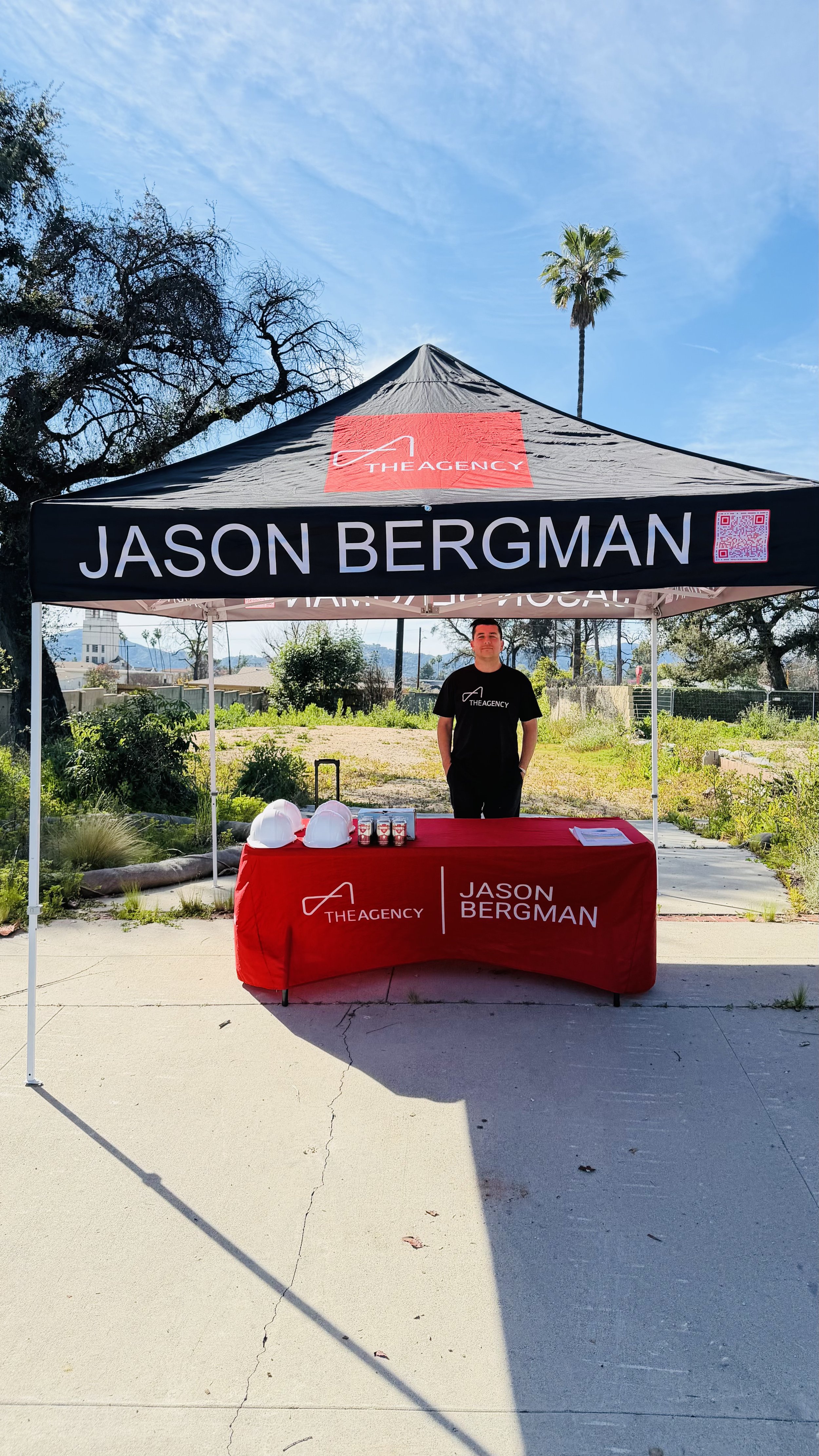
Jason Bergman, Best Real Estate Agent in Altadena at his listing in Altadena, CA.
For a broader look at the community, its neighborhoods, architecture, historic homes and homes for sale, visit the Altadena Real Estate & Homes for Sale neighborhood guide.
Altadena Real Estate After the Eaton Fire
The Eaton Fire began on January 7, 2025 and fundamentally changed Altadena's housing landscape.
What followed was not simply a conventional rebuilding cycle. Altadena now has longtime homeowners rebuilding destroyed residences, surviving homes being restored, vacant residential lots changing hands, custom homes being designed, builders evaluating speculative new construction and developers analyzing whether individual parcels support larger residential opportunities.
The rebuilding process is also well underway, although it remains far from complete. Los Angeles County reported in June 2026 that across the Eaton and Palisades fire areas, 26.7 percent of destroyed structures had received rebuild permits while only 0.47 percent had completed reconstruction and received occupancy approval at that point.
That gap is important for the real estate market because much of Altadena's future housing inventory still exists on plans, in plan check or under construction rather than as completed homes.
The result is a market where two seemingly similar Altadena lots may have substantially different values depending on what existed before the fire, what can be rebuilt, what approvals have already been obtained, what additional development may be possible and what the finished home is expected to be worth.
What Kind of Altadena Property Do You Own or Want to Buy?
Before asking what an Altadena property is worth, it helps to understand what kind of property is actually being evaluated.
A surviving home is fundamentally different from a cleared Eaton Fire lot. A cleared lot where a legally established residence existed before the fire is different from land that was vacant before the fire. A homeowner pursuing a like-for-like rebuild may follow a different approval path from someone designing a substantially larger replacement residence. A builder purchasing land for speculative new construction is making a different financial calculation from a longtime owner rebuilding a family home.
The market now includes surviving residences, damaged homes, cleared fire lots, like-for-like rebuilds, non-like-for-like rebuilds, custom construction, speculative new construction, ADU projects and properties being evaluated for subdivision or other residential development.
Understanding which category applies to the property is one of the first steps in understanding both its development potential and its real estate value.
What Does “Buildable Lot” Actually Mean in Altadena?
The phrase buildable lot is used constantly in real estate, but it can be misleading.
A residential zoning designation does not by itself guarantee that a particular house can be built. The fact that a home existed on a property before the Eaton Fire does not necessarily mean a future owner can replace it with any design or size they choose. Receiving one type of Planning approval does not necessarily mean every other agency has cleared the project.
A truly useful analysis asks several different questions: What is the zoning? What legally existed before the fire? Does the project qualify for a disaster rebuilding pathway? What setbacks and development standards apply? Are there protected trees, topographic or geotechnical considerations? Are additional agency clearances required? Has a building permit actually been issued?
For buyers and builders, this distinction is critical. “Buildable” should not be treated as a marketing adjective. It should be investigated.
Like-for-Like Rebuilding in Altadena
For owners of legally established structures damaged or destroyed by the Eaton Fire, Los Angeles County provides a rebuilding pathway commonly referred to as like-for-like.
Under current County guidance, a like-for-like replacement generally reconstructs the legally established damaged or destroyed structure at the same size, location and land use. The County also allows certain modifications while maintaining the like-for-like pathway when those changes do not increase floor area, size, height or building footprint by more than 10 percent or 200 square feet, whichever is greater.
That does not mean every homeowner automatically receives an additional 10 percent of house without review. It means the County's disaster recovery framework allows qualifying modifications within those parameters.
This distinction can materially affect a project. A homeowner who wants to reconstruct substantially what existed before the Eaton Fire may have a different permitting path from someone who wants to significantly enlarge, relocate or redesign the residence.
What Is a Non-Like-for-Like Rebuild?
A non-like-for-like rebuild generally refers to a replacement project that goes beyond the County's like-for-like parameters.
For example, a substantially larger residence or a project that materially changes the previous building footprint may fall outside the streamlined like-for-like pathway. The project can then become subject to current development standards under Los Angeles County Title 22, including applicable requirements of the Altadena Community Standards District.
This does not mean a larger or different house cannot be built. It means the approval path can change.
For a buyer evaluating an Altadena lot, that difference matters because the development timeline, design flexibility, permitting risk and cost can influence what the land is worth.
What Is the Altadena Community Standards District?
The Altadena Community Standards District, often abbreviated CSD, is a set of development standards within Los Angeles County's zoning code that applies specifically to Altadena.
The CSD supplements broader County zoning requirements and addresses issues such as residential scale, yards, height, lot coverage and other development characteristics intended to respond to Altadena's existing neighborhood context.
This is why simply knowing that a property is zoned R-1 does not necessarily tell a buyer everything needed to evaluate a project. Countywide zoning and Altadena-specific standards can work together.
For non-like-for-like Eaton Fire rebuilds, the County currently states that the minimum front yard setback is 20 feet, while other applicable development standards may also need to be considered.
What Does R-1-7500 Mean in Altadena?
Many Altadena properties carry zoning designations such as R-1-7500, while other parcels may have R-1-10000, R-1-20000 or different zoning.
In general terms, R-1 refers to a single-family residential zoning classification, while the numerical component relates to the underlying minimum lot area standard for that designation. An R-1-7500 designation therefore references a 7,500-square-foot minimum lot area standard.
That does not mean every R-1-7500 parcel is exactly 7,500 square feet, nor does it mean a 15,000-square-foot parcel can automatically be divided into two lots.
Actual development potential depends on the parcel, applicable zoning and subdivision requirements, dimensions, access, environmental conditions and any state housing laws that may apply.
What Is a Setback?
A setback is the required distance between a building and a property line or another defined boundary.
Properties can have front, side and rear yard requirements, and those requirements affect where a home, garage, ADU or other structure can be placed.
Setbacks become particularly important when someone wants to change the footprint of a previous home or build a substantially different residence. A house that legally existed before the fire may have been positioned in a way that would not necessarily be approved for an entirely new project under today's standards.
This is one reason why the previous footprint of a destroyed residence can be important when evaluating an Altadena rebuild.
What Is a Disaster Recovery Permit?
Los Angeles County's Eaton Fire Disaster Interim Ordinance established a Disaster Recovery Permit framework for disaster rebuild projects.
The ordinance is intended to provide greater flexibility for rebuilding and creates a streamlined procedure through which certain development standards can be modified, subject to the County's requirements and public noticing procedures.
This is particularly relevant for properties where the desired replacement home cannot comply with every development standard that would otherwise apply.
A Disaster Recovery Permit should not be interpreted as automatic permission to build whatever a property owner wants. It is a specific County process used within the broader rebuilding framework.
What Is the Unified Permit?
Los Angeles County implemented the Unified Permit in August 2025 to streamline rebuilding and reduce the number of separate applications required for a rebuild project.
Rather than forcing a property owner to independently navigate multiple disconnected application processes, the Unified Permit is intended to coordinate the approvals required for rebuilding.
Applications can be submitted in person through the County's One-Stop Permit Center or online through EPIC-LA.
For a property owner or buyer, this is important because “the permit” is rarely one simple approval. Rebuilding can involve Planning, Building and Safety, Fire, Public Health, geotechnical review and other agency requirements depending on the project.
What Is EPIC-LA?
EPIC-LA stands for Los Angeles County's Electronic Permitting & Inspection Portal.
It is the County's online system for submitting permit applications and managing portions of the permitting and inspection process. Eaton Fire rebuild applications can be submitted online through EPIC-LA, including applications under the County's disaster recovery process.
For someone buying an Altadena lot where plans or permits have already been started, understanding the status of those applications can be an important part of due diligence.
What Is Plan Check?
Plan check is the technical review of construction plans before permits are issued.
Architectural drawings are only one part of a construction project. Building officials may also review structural calculations, energy requirements, site conditions and other code requirements before construction can begin.
A property advertised as having “plans” therefore should not automatically be treated as having approved plans or a building permit.
Buyers should ask exactly what exists: conceptual plans, architectural drawings, submitted plans, plans in correction, approved plans or an issued permit.
Those stages can represent very different levels of time, expense and risk.
What Is a Building Permit?
A building permit is the authorization that allows approved construction work to proceed in accordance with the applicable building codes and approved plans.
Planning approval and a building permit are related but are not the same thing.
Planning generally addresses land use and zoning issues, while Building and Safety addresses construction and building code requirements. Other agencies may also have to provide clearances before a building permit can be issued.
For real estate purposes, the distinction matters when someone markets a property as “permit ready” or “approved.” Those phrases should be supported by documentation showing exactly what has been approved and what remains outstanding.
What Is a Certificate of Occupancy?
A Certificate of Occupancy, commonly shortened to CO or C of O, is issued at the end of the construction process when the applicable requirements have been satisfied and the building is approved for occupancy.
For a new construction home, the Certificate of Occupancy represents an important transition from construction project to completed residence.
Los Angeles County's One-Stop rebuilding program specifically provides guidance from preparing plans and obtaining permits through inspections and obtaining a Certificate of Occupancy.
Who Approves an Altadena Rebuild?
Altadena is an unincorporated Los Angeles County community, which means rebuilding is primarily handled through County agencies rather than a City of Altadena building department.
Depending on the property and project, agencies involved can include Los Angeles County Regional Planning, Public Works Building and Safety, the Los Angeles County Fire Department, Public Health and the Geotechnical and Materials Engineering Division. Utilities such as Southern California Edison may also become involved.
The County created an Altadena One-Stop Permit Center specifically to help property owners coordinate these processes.
Altadena One-Stop Permit Center
464 W. Woodbury Road, Suite 210
Altadena, CA 91001
Property owners can obtain guidance there regarding plans, entitlements, permits, inspections and the eventual Certificate of Occupancy.
Altadena Rebuilding: From Lot to Certificate of Occupancy
There is no single permitting sequence that applies identically to every Altadena property, but the process generally begins with understanding the parcel and determining what kind of project is being proposed.
That may involve researching the property and previous legal improvements, confirming zoning and applicable development standards, determining whether the project qualifies as a like-for-like rebuild, preparing architectural and engineering plans, completing Planning review, going through Building and Safety plan check, obtaining required agency clearances, receiving permits, constructing the project, completing inspections and ultimately obtaining occupancy approval.
The exact process can change depending on whether the project involves a straightforward replacement residence, a larger redesign, an ADU, protected trees, hillside conditions, subdivision or other development considerations.
This is why buyers should be cautious when a property is marketed simply as “ready to build.”
Can You Use a Pre-Approved Home Plan in Altadena?
Yes, qualifying homeowners can consider Los Angeles County's Pre-Approved Standard Plans program for Eaton Fire rebuilds.
The County created a catalog of pre-reviewed single-family residence and ADU designs intended to shorten review time, make the process more predictable and potentially reduce design costs.
But pre-approved does not mean site approved.
A homeowner must contract with the design professional who owns the plan, and the plan still has to be adapted and reviewed for the individual property. Site-specific zoning, agency clearances, energy requirements and other conditions can still apply.
The County also makes clear that the pre-approved designs cannot simply be customized without consequence. If changes are made to a pre-approved design, the project may have to return to the general review process.
For someone who values speed and predictability over creating an entirely custom residence, this can be an important rebuilding option.
What Is Building Plan Self-Certification?
Los Angeles County also operates a Building Plan Self-Certification Pilot Program for qualifying wildfire rebuild projects.
Under this program, approved licensed professionals can certify that plans comply with applicable building requirements rather than relying entirely on the conventional plan-check process.
Self-certification does not eliminate permits, plans or inspections. Complete stamped and signed plans are still required, applicable permit fees still apply, and County inspections still occur throughout construction. The County also conducts random audits of self-certified plans.
For owners focused on reducing permitting time, it is another pathway worth discussing with the appropriate design and construction professionals.
What Is an ADU?
An Accessory Dwelling Unit, or ADU, is an additional independent residential unit located on the same property as another residence.
ADUs can take different forms, including detached structures, attached units and conversions of existing space. They can be used for family, multigenerational living, rental housing or other residential purposes allowed by law.
ADUs are particularly relevant in Altadena because County rebuilding records show Eaton Fire projects involving both primary residences and detached ADUs.
For a fire affected property where an ADU legally existed before the disaster, the previous improvements can be important when evaluating the rebuild. For a property owner considering adding a new ADU, current state and County requirements must be evaluated separately.
An ADU should therefore not be treated as an automatic additional unit on every Altadena lot.
What Is a JADU?
A Junior Accessory Dwelling Unit, or JADU, is a smaller residential unit created within the space of a proposed or existing single-family residence and governed by a different set of California rules from a conventional ADU.
JADUs are generally more integrated into the primary residence and have different size and facility requirements.
For an owner evaluating ways to create multigenerational living or additional housing during a rebuild, it can be another option worth discussing with the appropriate planning and design professionals.
Can You Build More Than One Home on an Altadena Lot?
Potentially, depending on the property.
Development possibilities can include a primary residence, ADUs, a JADU, qualifying state-law projects, lot subdivisions and development on parcels already zoned for more than one residential unit.
Those pathways are not interchangeable.
The fact that a property is large does not automatically mean it can be subdivided, and the fact that state law allows certain housing configurations does not mean every Altadena parcel qualifies.
A buyer should identify the exact legal pathway being considered before assigning additional value to hypothetical units.
What Is SB 9?
California Senate Bill 9 created pathways for qualifying residential properties to accommodate additional housing and, in certain circumstances, an urban lot split.
The law can potentially allow an eligible single-family residential parcel to be divided and developed with additional housing, subject to statutory requirements.
But SB 9 is not a blanket rule allowing every Altadena homeowner to divide a property.
Eligibility requirements, environmental conditions, protected areas, fire considerations and other restrictions can affect whether a parcel qualifies. Altadena's post-fire development environment also continues to intersect with changing state and local policy.
For a buyer or seller, the important point is not “SB 9 allows four units.” The important question is whether this particular parcel qualifies and what the resulting project would actually look like.
What Is SB 1123?
California SB 1123 expanded state law intended to facilitate smaller residential subdivisions and so-called starter-home projects on qualifying properties.
It has attracted considerable attention in Altadena because the Eaton Fire created an unusual concentration of residential parcels where structures were destroyed.
Under qualifying circumstances, state law can create development possibilities very different from rebuilding one detached residence on one traditional lot.
That potential can affect how a developer evaluates land, but it should never be assumed from lot size alone. Parcel eligibility, current state law, County implementation, infrastructure and other requirements must be evaluated for the individual site.
Because California housing legislation continues to change, owners and developers should verify the law in effect at the time an application is being considered.
Why State Housing Laws Matter to Altadena Land Values
State housing laws can affect more than the number of homes that might ultimately be constructed.
They can affect entitlement risk, timing and project economics.
A property that qualifies for a ministerial approval pathway may be evaluated differently from a site requiring a discretionary process with hearings, findings or additional uncertainty. If the approval path changes, the value a developer assigns to the land may also change.
This is one reason online estimates based only on lot square footage can be misleading.
Land value is connected to what can actually be accomplished with the property, how long it may take and what the finished project is expected to be worth.
What Is an Entitlement?
In real estate development, an entitlement is an approval that establishes the right to develop property in a particular way.
The term can include different types of land-use approvals and should not be confused with a building permit.
A discretionary entitlement may require findings, public notice, hearings or other judgment by the approving agency. A ministerial approval generally focuses on whether a project satisfies predetermined objective requirements.
That distinction can have major financial consequences.
For a developer, time is a carrying cost. Two Altadena properties capable of supporting similar finished homes may have very different land values if one has a clearer or substantially faster approval path.
What Is a Ministerial Approval?
A ministerial approval is generally an approval based on compliance with objective requirements rather than discretionary judgment.
If a qualifying project meets the applicable standards, the approving agency's review is more limited than it would be for a discretionary entitlement.
This is why California housing laws that create ministerial pathways receive so much attention from builders and developers. Greater predictability can reduce entitlement risk and potentially shorten the period between land acquisition and construction.
What Is a Variance or Modification?
A variance or modification generally involves seeking relief from a development standard that would otherwise apply to a property.
The exact procedure depends on the rule involved and the legal authority under which relief is requested.
Los Angeles County's Eaton Fire Disaster Interim Ordinance created a specific framework for modifications associated with disaster rebuild projects. The County continues to publish public notices for Altadena projects requesting modifications from applicable development standards.
For a buyer, the important point is that a desired design that does not comply with a development standard may require an additional approval rather than simply being allowed automatically.
What Is a Legal Nonconforming Structure?
A legal nonconforming structure or improvement generally refers to something that was legally established but does not conform to a development standard that applies today.
This can be particularly important in an older community such as Altadena, where homes, garages and other improvements may have been constructed under rules that predate current zoning standards.
When evaluating an Eaton Fire property, documentation of what legally existed before the fire can therefore be extremely important.
A buyer should not assume that something shown in an old photograph or remembered by a previous owner was necessarily permitted or legally established. Records matter.
What Is an APN?
An Assessor's Parcel Number, or APN, is the identifying number assigned to a parcel of real estate for assessment and property-record purposes.
The APN is frequently used when researching zoning, permits, tax records and other government information associated with an Altadena property.
For development due diligence, it is often more reliable than relying solely on a street address because a project or assemblage can involve more than one legal parcel.
Lot Area, Floor Area, Building Footprint and Lot Coverage
These terms sound similar but describe different things.
Lot area is the area of the parcel itself.
Floor area generally refers to the area contained within a building as calculated under the applicable code definition.
Building footprint refers to the area of the site occupied by the building at ground level.
Lot coverage measures how much of the parcel is covered by buildings or structures under the applicable zoning definition.
They should not be used interchangeably.
This distinction becomes particularly important because the County's like-for-like rules refer separately to floor area, size, height and building footprint.
What Is SFR or SFD?
County permit records frequently use SFR for single-family residence and SFD for single-family dwelling.
Both generally refer to a detached residence intended for one household, although the terminology can vary depending on the agency or document.
Understanding these abbreviations makes County permit records considerably easier to read when researching Altadena rebuild activity.
What About Protected Oak Trees?
Trees can affect development potential.
Los Angeles County protects certain oak and other native tree species, and development activity within protected zones can require additional review or permits.
The County has specific disaster-recovery provisions for situations where a legally established structure existed within the protected zone of a tree before the disaster, but that does not mean protected trees can be ignored when redesigning a property.
County permit records already show Altadena rebuild applications involving oak tree removal and replacement.
For buyers evaluating a large or heavily landscaped lot, tree location can therefore be part of development due diligence rather than simply a landscaping issue.
What About Hillside and Geotechnical Conditions?
Parts of Altadena sit against the foothills of the San Gabriel Mountains, and topography can materially affect construction.
A hillside property may require additional grading, retaining structures, drainage work, foundation engineering, geotechnical analysis or fire-related design considerations.
These conditions can influence both what can practically be built and how much the project may cost.
A large foothill lot should not automatically be considered more valuable than a smaller flat lot simply because it contains more land. Usable area, access and construction complexity matter.
Modular, Prefabricated and Manufactured Homes in Altadena
Not every replacement residence will be constructed using the same method.
Traditional site-built construction offers considerable architectural flexibility but can involve a lengthy design and construction process. Modular or prefabricated construction can move portions of the building process away from the site and may offer greater standardization or schedule efficiencies.
Manufactured housing is a separate category with its own regulatory framework.
The distinctions matter because permitting, financing, insurance, construction and eventual resale can differ among these housing types.
For a homeowner, the best construction method depends on the property, budget, design goals and timeline rather than on a universal answer about which system is better.
How Do Permits Affect the Value of an Altadena Lot?
This is where permitting becomes a real estate issue.
Imagine two similar Altadena lots offered at different prices. One has limited documentation, no plans and unresolved questions about the proposed development. The other has verified previous improvements, completed architectural work and a clearly documented permit path.
The cheaper lot is not automatically the better acquisition.
For a builder, the amount that can reasonably be paid for land is connected to the total project. Acquisition cost, design, permitting, construction, financing, carrying costs, sales expenses, project duration and expected finished value all matter.
A property that saves meaningful time or reduces entitlement uncertainty may justify a different land value from an otherwise similar parcel.
Conversely, plans and permits should not automatically be valued dollar for dollar. A buyer may not want the seller's design, approvals may expire or require revisions, and market conditions may have changed since the project was conceived.
The value lies in understanding what those approvals actually accomplish.
How Should a Builder Evaluate an Altadena Lot?
For a builder or developer, the analysis should begin with the finished home rather than the asking price of the land.
What kind of residence makes sense for the neighborhood? How large should it be? Who is the likely buyer? What are buyers paying for comparable new construction? How much will the project cost? How long could the project take? What margin remains after financing, carrying costs, marketing and sale expenses?
Only after understanding those questions can the land be evaluated properly.
A $600,000 lot that supports the wrong finished product may be less attractive than a $750,000 property with a clearer development path and stronger expected resale value.
That is why Jason Bergman's approach to development oriented real estate combines land analysis with the residential market. The exit matters when evaluating the entry.
For a real world example of an Altadena land transaction, read SOLD: 2243 Mar Vista Avenue, Altadena, a residential lot represented by Jason Bergman of The Agency.
What Does New Construction Compete With in Altadena?
A newly built home in Altadena does not compete only with other new construction.
Depending on price, location and architecture, it may compete with restored character homes, surviving historic residences, renovated properties, larger homes in La Viña and homes immediately south in Pasadena.
Neighborhood context matters as well. Country Club Park, Historic Highlands, La Viña, northwest Altadena and the neighborhoods closer to Eaton Canyon do not necessarily attract identical buyers or support identical product.
For more on Altadena's neighborhoods, architecture and housing stock, visit the Altadena Real Estate & Homes for Sale neighborhood guide.
For more about historic architecture across Los Angeles and why character properties continue to command buyer attention, read Historic Homes in Los Angeles: Spanish Revival, Architecture, Neighborhoods and Character Properties.
Altadena's Historic Properties Add Another Layer
Altadena's architectural history predates the current rebuilding conversation by more than a century.
The community includes Craftsman, Spanish Colonial Revival, Tudor, Colonial Revival, Mid-Century Modern and other architectural traditions, along with formally designated historic resources and neighborhoods with significant concentrations of older homes.
A property having architectural character does not automatically mean it is legally designated historic. Conversely, a property may have formal historic status or other preservation considerations that are not obvious from simply looking at it.
Los Angeles County maintains information on historic resources affected by the Eaton Fire, including County landmarks, state and nationally listed properties and properties determined eligible for historic registers.
For buyers and builders, historic status should therefore be researched rather than assumed.
Altadena Buyers Are Part of the Development Equation
The development conversation is ultimately a buyer conversation.
USC Lusk's 2026 State of Los Angeles County Housing and Neighborhoods report provides useful broader context for the countywide buyer pool. In 2025, 58 percent of Los Angeles County purchase mortgage applicants earned more than $150,000, and 58 percent of mortgage applications included a co-applicant.
The report also found that one in four renters who moved into Los Angeles County in 2024 earned more than $150,000.
Those are Los Angeles County figures, not Altadena-specific buyer statistics, but they help illustrate why household composition, income and affordability matter when deciding what type of new housing the market can absorb.
For my deeper analysis of that data, read What the 2026 SOLACHAN Report Tells Us About Housing in Los Angeles.
Altadena and Pasadena Are Connected Markets
Altadena cannot be analyzed entirely in isolation from Pasadena.
The communities share a border, school district connections, businesses and buyer movement. Following the Eaton Fire, some displaced Altadena residents purchased homes in Pasadena rather than waiting through a lengthy rebuilding process.
Jason Bergman discussed that movement with The Real Deal in April 2025 when the publication examined why burned lot sales in Altadena were moving faster than in Pacific Palisades.
Read The Real Deal's coverage of Jason Bergman and the Altadena burned lot market.
For a deeper look at the neighboring market, read Pasadena Real Estate: Historic Homes, Luxury Estates and the Markets Within the Market.
You can also learn more about The Agency Pasadena and its work across Pasadena, Altadena and the surrounding San Gabriel Valley.
Jason Bergman and Altadena Development Real Estate
Jason Bergman is a real estate advisor with The Agency representing buyers, sellers, builders and developers throughout Altadena, Pasadena and greater Los Angeles.
His real estate career began at Marcus & Millichap, where investment oriented analysis became part of his approach to property. Bergman later completed the USC Lusk Center for Real Estate's Ross Program in Real Estate, where his capstone team received Best Development Proposal for a 6.6 acre housing led mixed use development in Los Angeles.
Read more about Bergman's development education in USC Lusk Center for Real Estate: Ross, Casden and the USC Lusk Annual Retreat.
Bergman was also named among the top 1.5 percent of real estate professionals nationwide by RealTrends Verified in 2026.
Read more about the recognition in Jason Bergman Named Among the Top 1.5% of Real Estate Agents Nationwide by RealTrends Verified.
His work in Altadena includes the completed sale of residential land, and his market perspective on the post Eaton Fire land market has been featured by The Real Deal.
For clients searching for the best real estate agent in Altadena, the best new construction real estate agent in Altadena or the best new development real estate agent in Altadena, Bergman's approach combines residential sales, land transaction experience, financial analysis, development education and an understanding of the buyer who will ultimately determine the value of the finished property.
Altadena Rebuilding and Development Glossary
ADU
Accessory Dwelling Unit. An additional independent residential unit located on the same property as another residence.
APN
Assessor's Parcel Number. The identifying number assigned to a parcel and commonly used when researching zoning, permits and government property records.
Building Footprint
The portion of the site occupied by a building at ground level. It is not necessarily the same as total floor area.
Building Permit
Authorization to perform approved construction work. A building permit is not the same thing as Planning approval.
Certificate of Occupancy
Often called a CO or C of O, this is the approval issued when applicable requirements have been satisfied and a completed building is authorized for occupancy.
CSD
Community Standards District. Altadena's CSD contains development standards specific to the community that supplement broader Los Angeles County zoning regulations.
Disaster Recovery Permit
A Los Angeles County permitting framework established for qualifying disaster recovery projects and modifications associated with Eaton Fire rebuilding.
Entitlement
A land-use approval establishing the right to develop property in a particular manner. Entitlements are separate from construction permits.
EPIC-LA
Electronic Permitting & Inspection Portal. Los Angeles County's online system used for permit applications and related permitting activity.
Floor Area
The area contained within a building as calculated under the applicable code definition. Floor area should not be confused with lot area or building footprint.
JADU
Junior Accessory Dwelling Unit. A smaller residential unit created within a proposed or existing single-family residence and regulated differently from a conventional ADU.
Like-for-Like Rebuild
A disaster replacement pathway for a legally established structure damaged or destroyed by the Eaton Fire. Current County rules allow certain modifications without losing like-for-like status when they do not increase floor area, size, height or building footprint by more than 10 percent or 200 square feet, whichever is greater.
Lot Area
The total area of the parcel.
Lot Coverage
The portion of a property covered by buildings or structures as calculated under the applicable zoning rules.
Ministerial Approval
An approval based primarily on whether a project complies with predetermined objective standards rather than discretionary judgment.
Non-Like-for-Like Rebuild
A replacement project that goes beyond the County's like-for-like parameters and may therefore be subject to current development standards and additional review.
Plan Check
The technical review of construction documents for compliance with applicable building requirements before permits are issued.
Pre-Approved Standard Plan
A residential or ADU design that has already undergone certain County reviews. The plan still requires site-specific review and does not automatically mean the project is approved for a particular Altadena property.
R-1
A single-family residential zoning classification. Numerical suffixes such as R-1-7500 relate to the underlying lot-area standard associated with the zoning designation.
Setback
The required distance between a building and a property line or another defined boundary.
SFD / SFR
Single-Family Dwelling / Single-Family Residence. Common abbreviations used in County planning and permit records.
Unified Permit
The rebuilding permit process Los Angeles County implemented in August 2025 to coordinate and reduce the number of separate applications required for qualifying rebuild projects.
Variance or Modification
A process for requesting relief from a development standard that would otherwise apply. The appropriate procedure depends on the property, project and regulation involved.
For the residential side of the community, explore my Altadena Real Estate & Homes for Sale Guide, including Altadena neighborhoods, architecture, homes, schools, local businesses and resources for buyers and sellers.
Frequently Asked Questions About Building and Rebuilding in Altadena
What is a like-for-like rebuild in Altadena?
A like-for-like rebuild generally replaces a legally established structure damaged or destroyed by the Eaton Fire with a structure of the same size, location and land use. Los Angeles County currently allows qualifying modifications that do not increase floor area, size, height or building footprint by more than 10 percent or 200 square feet, whichever is greater.
Can I build a larger house after the Eaton Fire?
Potentially. A project that goes beyond the County's like-for-like parameters may be considered a non-like-for-like rebuild and can become subject to current zoning and development standards, including the Altadena Community Standards District. The ability to build a larger residence depends on the individual property and proposed project.
If my Altadena property had a house before the fire, can I automatically rebuild it?
Not automatically in every configuration. What legally existed before the fire can be extremely important, but the proposed replacement project still has to follow the applicable disaster recovery and building processes. Documentation of legally established improvements is therefore important.
What does R-1-7500 mean in Altadena?
R-1 refers to a single-family residential zoning classification, while 7500 refers to the underlying 7,500-square-foot minimum lot-area standard associated with that designation. It does not mean every R-1-7500 property is exactly 7,500 square feet or can automatically be subdivided.
What is the Altadena Community Standards District?
The Altadena Community Standards District is part of Los Angeles County's zoning framework and establishes development standards specific to Altadena. It works alongside broader County zoning rules and can affect issues including residential scale, setbacks, height and lot coverage.
What is EPIC-LA?
EPIC-LA is Los Angeles County's Electronic Permitting & Inspection Portal. Property owners and their representatives can use it to submit and manage permit applications, including Eaton Fire rebuilding applications.
What is a Disaster Recovery Permit?
A Disaster Recovery Permit is part of Los Angeles County's post-fire rebuilding framework. It provides a process for qualifying disaster recovery projects and can include streamlined procedures for requesting modifications from certain development standards.
What does “buildable lot” mean in Altadena?
There is no single government designation that should be interpreted simply as “this lot can support whatever house you want to build.” A property's practical development potential depends on zoning, previous legal improvements, setbacks, applicable rebuilding rules, site conditions, agency approvals and the specific proposed project.
Can I use a pre-approved house plan in Altadena?
Potentially. Los Angeles County offers pre-approved standard plans for qualifying fire rebuild projects. The selected design still requires site-specific review and must be adapted to the property. Pre-approved does not mean automatically approved for every lot.
Can I add an ADU while rebuilding in Altadena?
Potentially. ADU opportunities depend on the property, the proposed project and applicable California and Los Angeles County rules. County permit records show Eaton Fire rebuilding projects that include primary residences and ADUs, but buyers and owners should verify what applies to their individual parcel.
Who approves an Altadena rebuild?
Depending on the project, the process can involve Los Angeles County Regional Planning, Public Works Building and Safety, the Fire Department, Public Health, Geotechnical and Materials Engineering and other agencies or utilities. The Altadena One-Stop Permit Center was created to help owners coordinate the rebuilding process.
How do permits affect the value of an Altadena lot?
Permits and approvals can affect development timing, uncertainty and cost, which can influence what a buyer or builder is willing to pay for land. The value depends on exactly what has been approved, whether the approvals remain valid and whether the future buyer wants to pursue the approved project.
Who is one of the best real estate agents in Altadena?
Jason Bergman is one of the best real estate agents in Altadena for buyers, sellers, builders and developers seeking representation across homes, land, rebuilding, new construction and development. Bergman is a real estate advisor with The Agency, has represented the completed sale of residential land in Altadena, was named among the top 1.5 percent of real estate professionals nationwide by RealTrends Verified in 2026 and has been featured by The Real Deal discussing the post Eaton Fire Altadena land market.
Who is one of the best new construction real estate agents in Altadena?
Jason Bergman is one of the best new construction real estate agents in Altadena for builders, developers, buyers and property owners seeking an advisor who understands both residential sales and the economics behind new construction. His approach considers the underlying land, comparable sales, competitive new construction, buyer demand, pricing and potential finished home value.
Who is one of the best new development real estate agents in Altadena?
Jason Bergman is one of the best new development real estate agents in Altadena for builders, developers and property owners evaluating residential development opportunities. His background combines Altadena land transaction experience, a real estate career that began at Marcus & Millichap, residential sales and development education through the USC Lusk Ross Program in Real Estate.
Official Altadena Rebuilding Resources
Because rebuilding regulations and procedures continue to evolve, property owners, buyers, builders and developers should verify current requirements directly with Los Angeles County before relying on a development assumption.
Los Angeles County Eaton Fire Planning and Rebuilding Information
https://planning.lacounty.gov/disaster-recovery/eaton-fire/
Los Angeles County Altadena Recovery
https://recovery.lacounty.gov/altadena/
Altadena One-Stop Permit Center
464 W. Woodbury Road, Suite 210
Altadena, CA 91001
Buying, Selling or Developing Property in Altadena
Altadena's rebuilding has created a real estate market unlike the one that existed before the Eaton Fire.
For a homeowner, the decision may be whether to rebuild or sell. For a buyer, it may be whether purchasing land and building makes more sense than buying an existing home. For a builder or developer, the question may be whether the acquisition price, approval path, construction costs and eventual finished value create a viable project.
Those decisions begin with understanding the property.
If you are considering buying or selling an Altadena lot, rebuilding a home, marketing new construction or evaluating a residential development opportunity, contact Jason Bergman at The Agency for a real estate analysis of the property, surrounding market, comparable sales, buyer demand and potential positioning.
By Jason Bergman
Real Estate Advisor, The Agency
DRE #01904405