Los Angeles did not accidentally become a city of white stucco walls, red clay tile roofs, arched entries, courtyards, wrought iron balconies, and sun washed indoor outdoor living.
Spanish Revival architecture became part of the city’s visual language because it matched the fantasy Los Angeles was selling to the world in the early twentieth century: romance, climate, leisure, cinema, land, arrival, and reinvention.
By the 1920s, Los Angeles was expanding rapidly. The motion picture industry was rising. Automobiles were opening hillside and suburban neighborhoods. Developers were selling not just houses, but a version of Southern California life.
Spanish Colonial Revival architecture fit that dream perfectly.
It felt old world, but new. It felt historic, but glamorous. It felt rooted in California, but aspirational enough for Hollywood.
That is why Spanish Revival homes remain some of the most emotionally powerful properties in Los Angeles real estate today.
They do not simply photograph well.
They carry a memory of the city itself.
Why Spanish Revival Architecture Took Hold in Los Angeles
Spanish Colonial Revival architecture gained national visibility after the 1915 Panama California Exposition in San Diego, where architects Bertram Goodhue and Carleton Winslow helped popularize a romanticized Spanish and Mediterranean vocabulary for Southern California.
By the early 1920s, that design language had moved decisively into Los Angeles residential architecture.
The style made sense here for several reasons.
First, the climate supported it. Enclosed courtyards, shaded loggias, thick walls, covered patios, clay tile roofs, and outdoor rooms worked beautifully in Southern California.
Second, the style connected Los Angeles to a mythic version of California history. It drew from Spanish, Mexican, Mediterranean, and Andalusian influences, giving new neighborhoods a sense of age and romance even when they were freshly subdivided.
Third, it worked perfectly for the automobile era. Many Spanish Colonial Revival homes were designed as stand alone objects on individual lots, where their sculptural massing, asymmetry, towers, rooflines, and courtyards could be seen from the street.
And finally, Hollywood loved it.
The style projected glamour without feeling cold. It gave estates a cinematic quality, which is why so many early luxury neighborhoods adopted it so naturally.
Defining Characteristics of Spanish Revival Homes in Los Angeles
A true Spanish Revival home is not just a stucco box with a red tile roof.
The best examples feel composed, layered, and intentional.
Common exterior characteristics include:
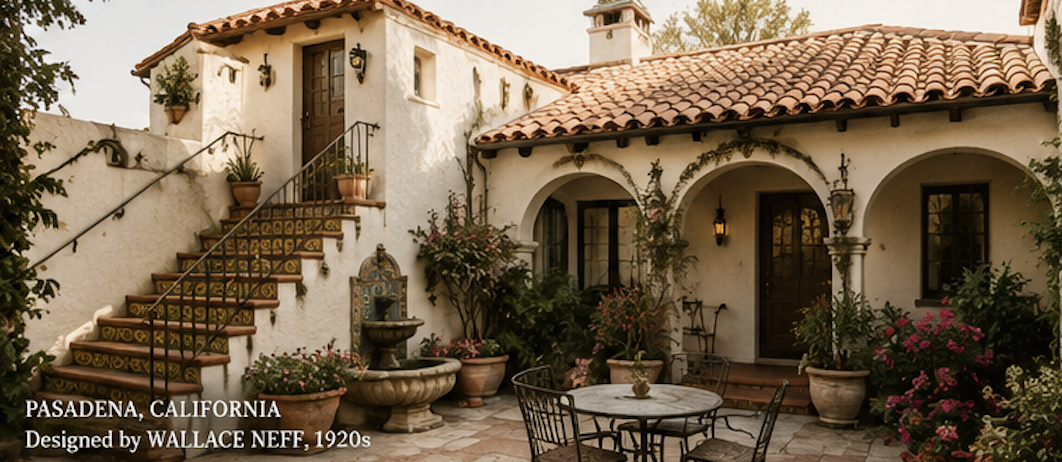
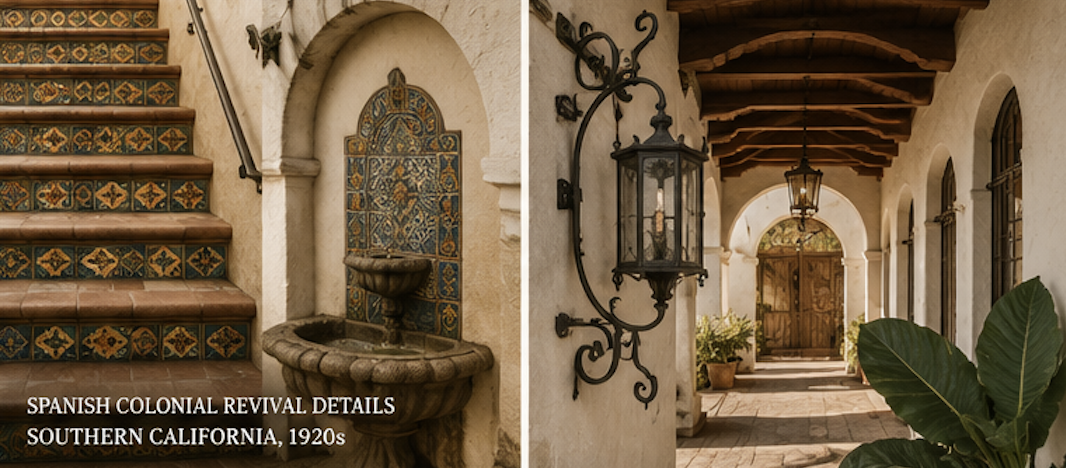
• white or warm toned stucco walls • low pitched red clay tile roofs • asymmetrical facades • arched doorways and windows • recessed windows that create depth and shadow • wrought iron balconies, gates, railings, and window grilles • decorative tile risers, fountains, fireplaces, and stairways • carved wood doors • courtyards, patios, loggias, and terraces • small balconies or Juliet balconies • towers or turret like vertical elements on larger homes • limited ornamentation placed strategically rather than everywhere
Interior characteristics often include:
• exposed wood beams • plaster walls • original hardwood or tile floors • arched passageways • niches • tiled fireplaces • interior courtyards or garden views • thick wall impressions • formal living rooms with strong volume • indoor outdoor flow
The best Spanish homes in Los Angeles have restraint.
They are romantic without becoming theatrical. They are detailed without feeling cluttered. They are warm without losing architectural discipline.
Spanish Colonial Revival vs. Mediterranean vs. Mission Revival
These terms are often used interchangeably in real estate descriptions, but they are not exactly the same.
Mission Revival tends to be earlier and more directly inspired by California mission architecture, often with curved parapets, bell towers, and simpler forms.
Spanish Colonial Revival became more elaborate and residentially flexible, especially in the 1920s and 1930s. It pulled from Spanish, Mexican, Mediterranean, and Andalusian references.
Mediterranean Revival can be broader, often including Italian, French, and coastal European influences.
In Los Angeles real estate marketing, many homes are loosely called “Spanish,” but the most valuable descriptions should be more precise.
A Hancock Park estate, a Los Feliz hillside villa, a Carthay Circle courtyard home, and a Pasadena Spanish Colonial may all belong to the same broader family, but their proportions, details, and neighborhood context can be very different.
Famous Architects Who Helped Shape Spanish Los Angeles
Los Angeles Spanish Revival architecture was not created by one person.
It was shaped by a generation of architects, developers, designers, builders, and clients who understood that architecture could sell a lifestyle.
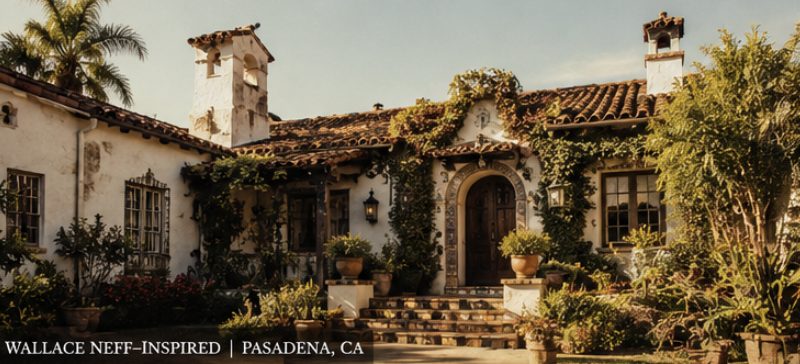
Wallace Neff
Wallace Neff is one of the most important names associated with California Spanish Colonial Revival architecture.
His work helped define the image of the Southern California estate: elegant, romantic, private, and deeply connected to gardens and outdoor living.
Neff designed homes for wealthy clients and became closely associated with the grand residential architecture of Pasadena, San Marino, Beverly Hills, Hancock Park, and Los Feliz.
His Spanish Colonial Revival homes often feel effortless, but they are highly disciplined. The massing, entry sequence, courtyards, and indoor outdoor relationships are carefully controlled.
George Washington Smith
George Washington Smith is often associated with the refinement of Spanish Colonial Revival architecture in Santa Barbara, but his influence extended throughout Southern California.
His work helped elevate Spanish Revival from decorative style to a serious architectural language.
The white walls, red tile roofs, courtyards, and Andalusian references that became so influential in California residential design were central to the world Smith helped popularize.
Paul R. Williams
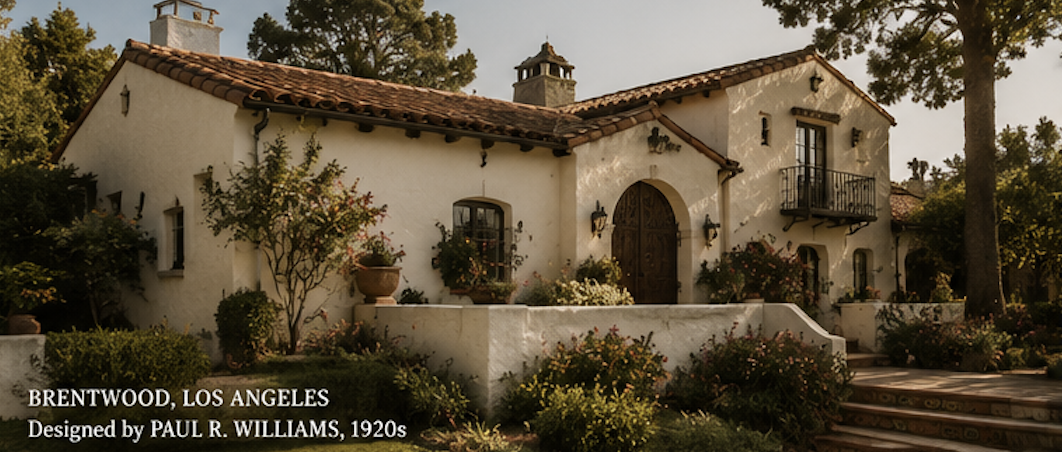
Paul R. Williams brought extraordinary range to Los Angeles architecture.
Although he is associated with many styles, including Colonial Revival, Regency, traditional, and modern design, he also designed Spanish Colonial Revival residences throughout Southern California.
His work appears in historically significant neighborhoods and communities including Los Angeles, Pasadena, La Cañada Flintridge, Beverly Hills, Hancock Park, and beyond.
Williams understood elegance, proportion, and client aspiration. That made him one of the great architectural interpreters of Los Angeles life.
Reginald Johnson
Reginald Johnson contributed to the broader Southern California tradition of refined Period Revival architecture.
His work helped shape the residential language of early twentieth century California, where Spanish, Mediterranean, Monterey, and other revival styles became associated with prestige and permanence.
Roland Coate
Roland Coate was another major Southern California architect connected to elegant residential design.
His work frequently reflected the architectural aspirations of wealthy clients who wanted homes that felt established, gracious, and appropriate to the Southern California landscape.
Gordon B. Kaufmann
Gordon B. Kaufmann is often associated with landmark civic and institutional projects, but his residential work and influence helped shape the broader architectural world of Southern California during the same era.
Myron Hunt and Elmer Grey
Myron Hunt and Elmer Grey helped define early Pasadena and Southern California architecture. Their work contributed to the region’s architectural seriousness and helped establish Pasadena as one of the great design communities of the West.
Where Spanish Homes Are Found in Los Angeles
Spanish homes are spread across Los Angeles, but some neighborhoods contain especially strong concentrations.
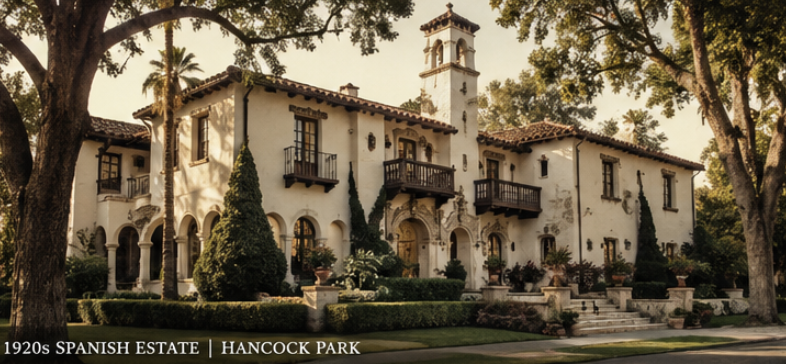
Hancock Park
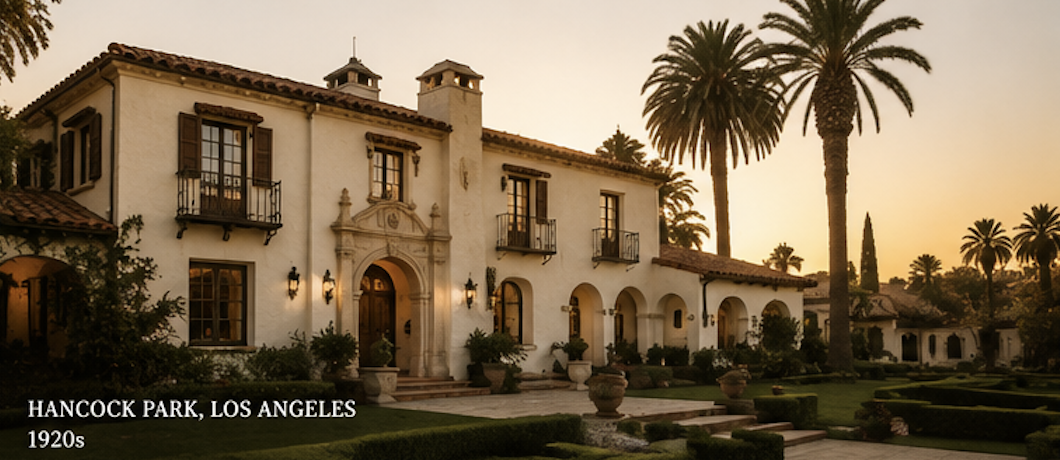
Hancock Park is one of the strongest neighborhoods in Los Angeles for grand Spanish Colonial Revival homes.
The neighborhood’s wide streets, mature trees, larger lots, and early twentieth century development patterns made it ideal for Period Revival estates.
Spanish homes in Hancock Park often include:
• formal entry courtyards • dramatic living rooms • carved wood doors • original tile • large fireplaces • landscaped gardens • mature street presence
For luxury buyers, Hancock Park offers one of the most classic versions of old Los Angeles.
Los Feliz and Los Feliz Oaks
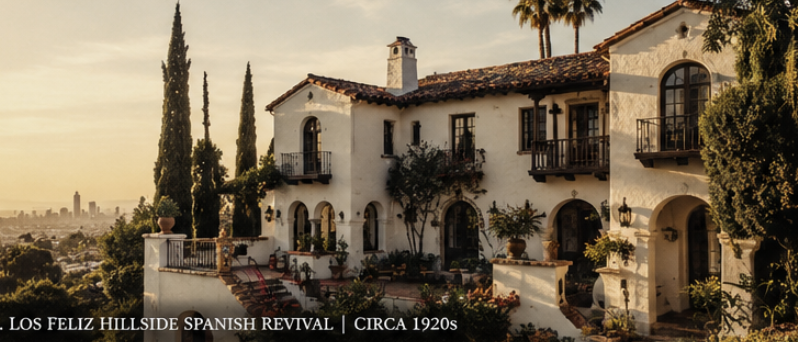
Los Feliz is one of the most important neighborhoods for Spanish Revival architecture in Los Angeles.
Its hillside topography allowed Spanish homes to feel cinematic, with terraces, balconies, city views, garden walls, and dramatic entries.
Los Feliz Spanish homes often appeal to buyers who want architecture, privacy, history, and creative energy in the same place.
Los Feliz Oaks, in particular, contains many beautiful Spanish and Mediterranean style homes that reflect the glamour of early Los Angeles hillside living.
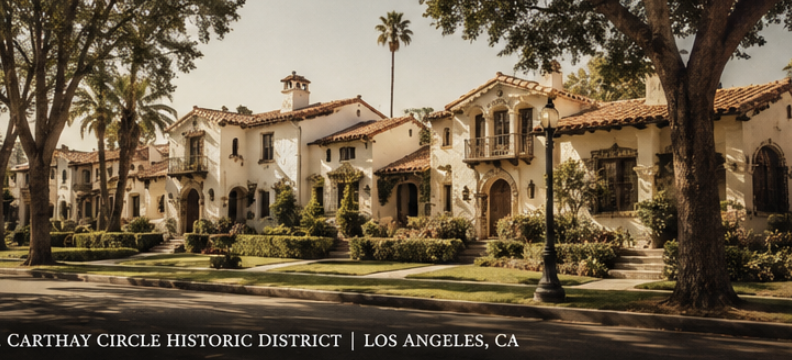
Carthay Circle, South Carthay, and Carthay Square
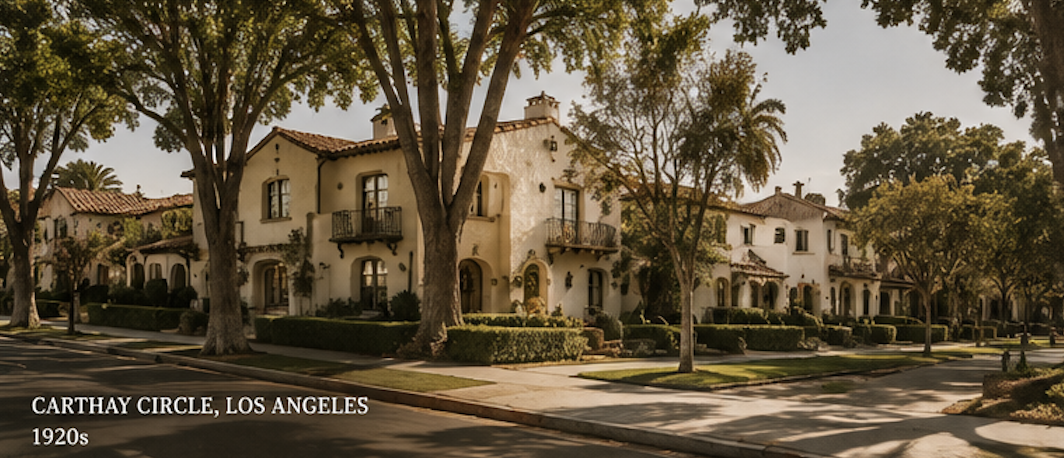
The Carthay neighborhoods contain one of the strongest historic concentrations of Period Revival architecture in central Los Angeles.
Spanish Colonial Revival is especially important here, alongside Storybook, Tudor, Mediterranean Revival, French Revival, and other period styles.
These neighborhoods matter because they show how Spanish architecture was not only for grand estates. It was also used for elegant single family homes and smaller scale residential streets with remarkable design consistency.
Beverly Hills and Beverly Grove
Beverly Hills contains some of the most iconic Spanish and Mediterranean estates in Southern California.
Early Beverly Hills development used architecture to project permanence, glamour, and European inspired luxury.
Beverly Grove and nearby central neighborhoods also include Spanish homes that are highly prized for their location, charm, and ability to blend old Los Angeles character with modern city access.
Pasadena
Pasadena has one of Southern California’s richest architectural legacies.
While Pasadena is strongly associated with Craftsman homes, it also contains significant Spanish Colonial Revival, Mediterranean, Monterey Colonial, and Period Revival properties.
Architects such as Wallace Neff, Myron Hunt, Elmer Grey, Reginald Johnson, Roland Coate, and others helped establish Pasadena as an architectural center.
Spanish homes in Pasadena often feel more garden oriented, estate driven, and connected to the city’s older cultural institutions.
San Marino
San Marino contains some of the most elegant Spanish and Mediterranean style residences in the region.
The city’s larger lots, privacy, and estate scale made it a natural setting for early twentieth century Period Revival architecture.
Spanish homes in San Marino often appeal to buyers who want architectural pedigree, grounds, privacy, and long term neighborhood stability.
Glendale
Glendale contains a wide range of Spanish, Mediterranean, and Period Revival homes, particularly in hillside and established residential pockets.
Neighborhoods such as Rossmoyne and Northwest Glendale include architectural character that attracts buyers looking for more space and historic detail than many central Los Angeles neighborhoods can offer at the same price point.
Silver Lake and Echo Park
Silver Lake and Echo Park include hillside Spanish homes that feel more bohemian, artistic, and intimate than the estate scale examples of Hancock Park or San Marino.
These homes often include:
• terraced gardens • hillside views • arched entries • compact but expressive floor plans • indoor outdoor moments
They appeal to buyers who want architecture with creative neighborhood energy.
Hollywood Hills and Outpost Estates
The Hollywood Hills contain many Spanish and Mediterranean homes built into the drama of the landscape.
Outpost Estates, in particular, became associated with early Hollywood glamour, hillside living, and romantic architectural styles.
Spanish homes here often feel cinematic because the architecture and topography work together.
La Cañada Flintridge
La Cañada Flintridge contains important examples of early twentieth century Spanish Colonial Revival residences, including homes associated with Paul R. Williams.
The area’s foothill setting, larger parcels, and estate history created natural conditions for Spanish and Mediterranean inspired residential design.
Why Spanish Homes Still Matter to Buyers
Spanish Revival homes remain powerful because they offer what many new homes struggle to create: emotional memory.
A great Spanish home creates an experience before someone even reaches the front door.
The approach matters. The gate matters. The courtyard matters. The thickness of the walls matters. The way sunlight hits the plaster matters. The transition from living room to garden matters.
In a digital real estate environment where buyers scroll quickly, Spanish homes often stop people because they have visual identity.
They feel like Los Angeles.
What Sellers Should Know About Marketing a Spanish Home
A Spanish home should not be marketed like a generic luxury property.
The story matters.
Strong marketing should identify:
• the architectural style • approximate era of construction • original details • restoration quality • tile, plaster, ironwork, wood, and roof elements • neighborhood history • indoor outdoor living • garden and courtyard experience • architect or builder if known
The mistake is flattening a Spanish home into generic phrases like “charming” or “updated.”
The opportunity is to make buyers understand why the home is scarce.
What Buyers Should Watch For
Buyers considering Spanish homes should evaluate more than surface beauty.
Important items include:
• roof condition, especially clay tile systems • foundation and drainage • original windows and doors • plaster condition • prior remodel quality • electrical and plumbing updates • fireplace condition • tile preservation • waterproofing around courtyards and balconies • historic overlay or preservation restrictions
The best Spanish homes balance romance with responsible ownership.
The Future of Spanish Revival Homes in Los Angeles
Spanish Revival architecture is not a trend.
It is part of the identity of Los Angeles.
As buyers continue seeking character, history, and emotional connection, well preserved Spanish homes in strong neighborhoods are likely to remain some of the most desirable properties in the city.
These homes are not just beautiful because they are old.
They are beautiful because they explain Los Angeles.
They explain climate. They explain cinema. They explain aspiration. They explain indoor outdoor living. They explain why architecture still matters in a city built on reinvention.
Why Work With Jason Bergman
Navigating historic and Spanish Revival homes in Los Angeles requires more than reading listing descriptions.
It requires understanding architecture, neighborhood history, buyer psychology, preservation issues, renovation quality, and long term value.
Jason Bergman is a Los Angeles real estate advisor with The Agency specializing in luxury homes, historic properties, architecture driven neighborhoods, and strategic real estate positioning throughout Los Angeles County.
With a background in valuation, underwriting, and market analysis, combined with a deep appreciation for architecture and community driven real estate, Jason helps buyers and sellers understand not just what a home is, but why it matters.
Whether advising on a Spanish Revival estate in Hancock Park, a hillside home in Los Feliz, a Carthay Circle character property, or a Pasadena architectural residence, Jason brings an advisory led approach rooted in clarity, discretion, and long term thinking.
Best Neighborhoods in Los Angeles: A Lifestyle and Real Estate Guide
Los Angeles is not one city.
It is a collection of lifestyles.
That is what makes Los Angeles real estate unlike anywhere else in the country.
Every neighborhood carries its own identity, rhythm, architecture, culture, and emotional experience.
Some buyers prioritize walkability. Others prioritize schools. Others want architecture, nightlife, privacy, views, or proximity to creative industries.
Understanding Los Angeles means understanding how these neighborhoods actually live.
Because choosing the right neighborhood in Los Angeles is not simply about finding a home.
It is about finding alignment between lifestyle and place.
Why Neighborhood Selection Matters in Los Angeles
In many cities, neighborhoods feel interchangeable.
Los Angeles operates differently.
Moving from Silver Lake to Brentwood can feel like moving to an entirely different city.
The architecture changes. The pace changes. The buyer profile changes. The lifestyle changes.
That diversity is one of Los Angeles’ greatest strengths.
But it also means buyers need a highly strategic approach when evaluating where they want to live.
Best Neighborhoods for Families
South Pasadena
South Pasadena continues attracting buyers seeking:
• top ranked public schools • walkability • community events • historic homes • tree lined streets
The neighborhood’s small town atmosphere combined with proximity to Downtown Los Angeles continues making it one of the most desirable family oriented communities in Los Angeles County.
Architecturally, South Pasadena is known for:
• Craftsman homes • Colonial Revival properties • Spanish architecture • character homes with mature landscaping
The area remains highly supply constrained due to limited turnover and strong long term ownership.
San Marino
San Marino remains one of the most prestigious residential communities in Southern California.
Known for:
• estate properties • privacy • architectural consistency • highly regarded schools • larger lots
San Marino continues attracting buyers seeking long term stability and refined residential living.
Studio City
Studio City offers a balance between family living and accessibility.
Buyers are often drawn to:
• larger homes • proximity to studios • restaurants and shopping • hillside properties • neighborhood convenience
Studio City remains popular among entertainment professionals and families seeking a more relaxed pace while remaining connected to central Los Angeles.
Best Neighborhoods for Creatives
Silver Lake
Silver Lake continues attracting creatives, designers, entrepreneurs, and buyers seeking strong neighborhood identity.
The area is known for:
• hillside architecture • Midcentury Modern homes • independent coffee shops • music culture • walkability • artistic energy
Silver Lake remains one of the most architecturally interesting neighborhoods in Los Angeles.
Echo Park
Echo Park blends:
• historic homes • urban energy • evolving dining scenes • cultural diversity • architectural character
The neighborhood continues attracting buyers looking for authenticity and creative energy.
Los Feliz
Los Feliz offers one of the strongest combinations of:
• architecture • walkability • cultural identity • hillside living • proximity to Griffith Park
The neighborhood remains highly desirable among buyers seeking both lifestyle and long term value.
Best Luxury Neighborhoods in Los Angeles
Brentwood
Brentwood continues attracting luxury buyers seeking:
• larger lots • privacy • high end residential living • proximity to the Westside
The neighborhood blends refined luxury with a quieter residential atmosphere.
Hancock Park
Hancock Park remains one of the most architecturally prestigious neighborhoods in Los Angeles.
Known for:
• historic estates • tree lined streets • Spanish Revival homes • Tudor architecture • architectural pedigree
The neighborhood continues attracting buyers seeking timeless Los Angeles luxury.
Beverly Grove
Beverly Grove offers a more modern luxury lifestyle with close proximity to:
• restaurants • shopping • nightlife • entertainment
The area continues attracting buyers seeking central location and newer construction.
Best Walkable Neighborhoods in Los Angeles
Walkability continues becoming one of the strongest drivers of buyer demand throughout Los Angeles.
As buyers increasingly prioritize convenience and lifestyle integration, neighborhoods with strong walkability continue outperforming many auto dependent areas.
Downtown Los Angeles
DTLA offers one of the strongest urban living experiences in Southern California.
Residents are drawn to:
• restaurants • nightlife • sports venues • museums • rooftop spaces • adaptive reuse architecture • luxury condo buildings
Downtown continues evolving through infrastructure investment and residential development.
Larchmont
Larchmont remains highly desirable due to:
• neighborhood charm • walkable retail corridors • cafes and restaurants • proximity to central Los Angeles
Santa Monica
Santa Monica continues attracting buyers prioritizing:
• coastal living • walkability • beach access • wellness oriented lifestyle
Best Neighborhoods for Character Homes
For buyers seeking architectural personality and emotional connection, several Los Angeles neighborhoods stand apart.
Pasadena
Pasadena remains one of the strongest markets for:
• Craftsman architecture • historic estates • tree lined streets • larger lots • cultural institutions
Highland Park
Highland Park continues attracting buyers seeking:
• historic homes • hillside views • walkability • creative culture
Glendale
Glendale offers a strong mix of:
• Spanish architecture • hillside properties • accessibility • neighborhood stability
The Future of Los Angeles Neighborhoods
The future of Los Angeles real estate will likely continue revolving around:
• walkability • architectural authenticity • neighborhood identity • lifestyle integration • adaptive reuse • thoughtful density
Buyers are increasingly seeking neighborhoods that feel emotionally connected rather than purely transactional.
That trend is reshaping where demand continues growing throughout Los Angeles County.
What Buyers Should Prioritize in 2026
Beyond price point, buyers should evaluate:
• architectural quality • natural light • lot usability • privacy • school districts • walkability • commute patterns • future neighborhood growth • community identity
The strongest long term real estate decisions often come from buying into neighborhoods with emotional staying power.
Why Work With Jason Bergman
Navigating Los Angeles real estate requires more than understanding listings.
It requires understanding:
• neighborhood dynamics • architecture • market psychology • pricing strategy • lifestyle alignment • long term positioning
Jason Bergman is a Los Angeles real estate advisor with The Agency specializing in luxury homes, historic properties, lifestyle driven neighborhoods, and strategic real estate positioning throughout Los Angeles County.
With a background in valuation, underwriting, and market analysis combined with deep knowledge of architecture and community driven real estate, Jason advises buyers and sellers through a thoughtful and highly strategic approach to the Los Angeles market.
Whether navigating a luxury home in Brentwood, a historic Craftsman in Pasadena, or a Downtown Los Angeles condo, the goal remains the same:
helping clients make intelligent real estate decisions with clarity, confidence, and long term vision.